Westminster News

Wilberforce Address with Rt Hon Michael Gove MP

Friday, 9 December, 2011

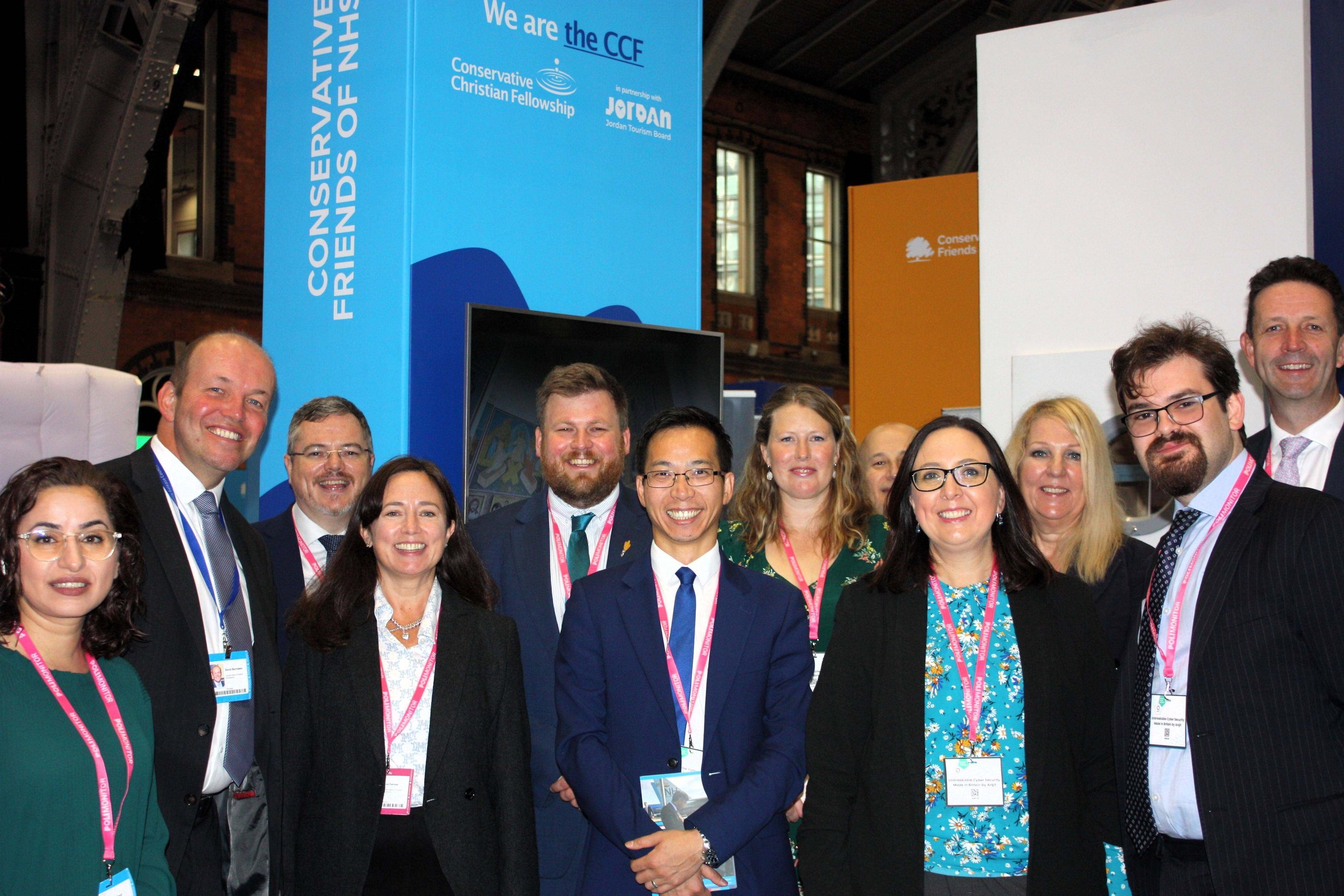
At the CCF's Annual Wilberforce Address there was over 150 MPs, Peers, Christian leaders and CCF members. The Address given by Rt Hon Michael Gove MP, Secretary of State for Education, is available in full below:

“Thank you very much Colin and thank you ladies and gentlemen for coming along this evening.  Colin, I have to say you are doing a fantastic job, but a very high bar has been set already.  I don’t know if Elizabeth Berridge, who I am delighted is now Baroness Berridge, is here with us this evening, but I have to say Elizabeth what you did when you were leading CCF has been wonderful.  It’s a joy that you are now in the House of Lords and you are a champion for all that is right in the Conservative Party and in public life and thank you for everything that you have done and are doing.

“It’s a pleasure to have as well as Elizabeth so many distinguished parliamentarians and colleagues of mine from the House of Commons and the House of Lords here and also a pleasure that civil society is so richly represented here this evening.  It’s a great honour for me to be invited to deliver an address following in the footsteps of my cabinet colleagues and previous party leaders and in particular it’s a privilege to be asked to say a few words which are dedicated to the memory of William Wilberforce.

“Wilberforce’s example stands before all parliamentarians as a model of what public service should be.  And it’s striking I think still that there are many who are surprised that when they hear the story of Wilberforce and the huge impact that he made on the conscience of the nation.  They find it odd that he was a Conservative because they presume that someone who is a crusader, someone who believes so powerfully in the dignity of each individual human soul and someone who fought so energetically against injustice should be on the right of politics.  But I don’t think that there is any contradiction between Wilberforce’s crusading passion for justice and his having defined himself in his political career as being on the right.  I think the two marry perfectly.  And the reason why I think they marry so well in his person is because of an intuition and understanding that he had, that I suspect all of us have here.

“There are good people and bad in every political party.  There are good people and bad of every faith and none, but there are certain things that people of faith and Conservatives understand about the way that human society is organised.  One of them is that the liberal, admirable in his or her own way, believes in the primacy of the individual and the socialist or progressive, often admirable in their way believes in the primacy of the state.  What we believe in is the primacy of relationships, the isolated individual on their own can never achieve in a political system built around the rights of the individual and nothing else, descends into selfishness, hedonism and atomisation.  A political system built around the state may appeal to our patriotism but sometimes it calcifies into authoritarianism and distance.  But a politics that is based on relationship understands that the most important and enriching things in all our lives are the intimate human relations that we have with others, with figures of authority and those whom we have authority over, with those whom we elect and those whom we serve.  And that politics of relationships, that understanding that you are bound to other human beings by more than simply economic ties, but you are bound to them because you like them embody a divine spark, creativity and talent.  That recognition shapes the politics and has shaped the politics of Conservatives and of people of faith for generations and it shapes the politics of all of us, I know.  That one of the things that’s drawn us, whatever our backgrounds, into service to others, is our belief that deepening the quality of relationships and strengthening the number of relationships that each of us has, is the way to generate a greater sense of well being, of opportunity and of fulfilment.  And one of the things that I suspect that everyone in this room recognises is that sacrificing something of one’s self and choosing to put one’s own personal ambitions to one side in order to generate a spirit of service to others is actually the most fulfilling thing that we can do.  One of the reasons that we are here. 

“I want to honour Wilberforce for embodying that sprit in politics and it is a spirit which we have seen in so many others throughout the history of our party.  Whether it is the approach that Shaftesbury took or the approach that Chamberlain and Baldwin took to social reform in the 1930’s or the approach that has categorised the work of Iain Duncan Smith both in opposition and in Government.  That belief that Conservatism is about enriching the quality of human relationships and about strengthening the bond of obligation that we owe the one to the other.  It’s critical.

“I also wanted to say a word this evening about the title that I have chosen for this address.  I am aware that speaking to you, the Conservative Christian Fellowship, I was going to speak to one of the most scripturally literate audiences in the country.  Certainly more so than the Synod of the Church of England or the General Assembly of the Church of Scotland.

“I thought that it might be appropriate to take a text, but I am not a preacher, so I am not going to analyse each part of that text and look back at the original Greek or Hebrew.  What I am going to do, is to take a parable, a parable that has had an impact on me as it has had an impact on many other politicians who have engaged with education and it’s the ‘Parable of the Talents’.  You will know it better than I.  But in it you will remember that there are three individuals who are given literally talents, coins, and two of those three use their talents.  And they return in equal measure what they have been given but there is one individual who buries his talent away.  And he does so because he believes that he’s literally respecting what he’s asked to do but in so doing he doesn’t display any curiosity or ambition or desire to improve that which was settled on him. 

“The parable also tells that each of the three individuals were given different talents.  One five, one two, and one, one.  And the parable resonates across the centuries because it speaks to something very true about the human condition and something resonant about human ambition.  The first thing it acknowledges is that all of us do have different talents.  Some of us have the gifts of eloquence or intelligence or wisdom or foresight but with the others, not so gifted in those conspicuous ways, who have other gifts of gentleness or forbearance or kindness, yet others who will have talents in the field of sport or music or art but I believe that every single one of us will have a talent.  And sometimes that talent may exist in generating warmth and love and charity in others.  I think one of the most striking things is that is it often the case that there are people who appear not to have the intellectual ability or the physical charm or the career enhancing qualities that the world currently values, who may be overlooked but they will have a talent for inspiring love and devotion in others and that talent is as worth nurturing as any.   The parable of course acknowledges that each of us have those individual and different talents and it reflects on the fact that anyone who is in charge of education has to work hard to find out what the talents of individuals are and give them an appropriate platform.

“But the parable also places an injunction on those who have those talents, to use them.  And one of the things that I am conscious of, as Secretary of State for Education, is that we are not using all the talents of all our people to the utmost in this country.  And of course whenever any Education Secretary makes a remark like that there is always a tendency for some to say, “ah, there he goes, he’s a pessimist, he’s accentuating the negative, this is a prelude to a criticism of our young people and how things were much better in his day.”  Well let me nail each of those myths on the head.  I am not a pessimist, I am an optimist about human nature and potential.  I think there is almost no limit to what young people in this country can achieve, if well-led, well-educated and provided with the right values.  Nor am I a narrow nostalgist, I actually think that our schools and the education that young people receive today is far better, richer, wider, more humane and tolerant than it was in my day.  I also think that we have a tremendous generation of teachers in our schools.  The best ever and the best generation of Heads leading them.  I also think that the overwhelming majority of young people work harder today and have a more developed social conscience than the children of my generation when we were growing up.  So there are reasons to be cheerful, indeed grounds for optimism. 

“But while we can be optimistic about the future, we need to be realistic about our present state and some of the deficiencies in our education system.  Every year our young people will sit exams.  And every year the Government of the day is tempted to say how much better children have done this year than last or five years ago or ten years ago and it’s instructive yes.  The children are benefiting from improved examination grades but the most critical test is not how we are doing compared to a generation ago or five years ago, the most instructive test with our education system is how are we doing relative to other nations?  Because increasingly our world is one world.  The jobs of the future are capable of being transported, exported from this country elsewhere.  When you ring your mobile phone supplier in order to upgrade, you will find yourself patched through to a call centre in the Indian sub-continent.  If you reflect on the miracles that radiography is capable of generating in our National Health Service hospitals it may well be the case that that radiographers set of x-rays has been faxed or electronically transmitted from across the globe.  There are jobs both high and low, technical, professional and manual, that exist across the globe that are capable of being shifted from here as a result of economic forces sometimes apparently beyond our control.  And for that reason if we are to ensure that our young people have the maximum level of opportunity in the future we need to make sure that they are educated every bit as well as the young people in other countries.  And the tragedy is that they are not. 

“In the last ten years, the international measures of how well we are doing as a country tell a melancholy story.  We have fallen from fourth in the world for the quality of our science education to sixteenth.  We have fallen from seventh in the world for quality of our children’s literacy to twenty-fifth and from eighth in the world for the quality of mathematics to twenty eighth.  And what makes this, to my mind, melancholy trend even sadder, is the fact that as we move backwards another gap has opened up.  Not just the gap between this country and others, but the gap between rich and poor in our own nation. 

“Under Labour, the gap between the academic performance of students in independent fee paying schools and state schools doubled and the allocation of opportunity between rich and poor shifted decisively in favour of the rich.  We all know that the poorer students in our schools are those that are eligible for free school meals and we know there are some parents who deliberately choose not to claim that benefit for reasons of pride and it’s an imperfect measure but it’s the best we have.  And each year there are 600,000 students in every school year and of those there are 80,000 who are eligible for free school meals.  In the last year for which we have figures, out of those 80,000, just 40 made it to Oxford or Cambridge.  So fewer children, eligible for benefits made it to those two Universities, than children from Eton or Westminster or St Paul’s School for Girls.  David Cameron’s old school, sent more of children to a top university, than the entire population on benefits.  Nick Clegg’s old school sent more children and Harriet Harmen’s old school sent more children.

“And if we look more broadly we can also see that across this country the proportion of students who go on to our best universities, from our poorest and from state schools is tiny.  Only 0.5% of pupils in maintained schools, manage to make it to Oxbridge.  In towns like Reading the entire population of children who make it to Oxbridge come from just two schools.  Two superb schools, Reading School and Kendrick but they are selective schools.  No pupils at all progressed to Oxbridge this year from Portsmouth.  Although over half the schools in authorities which had pupils progressing were from schools which were independent.  It’s a massive waste of talent.  More than that, it’s an affront to all our consciences because we should be, just as Wilberforce was, animated by a deep and burning sense of anger at the way in which many souls in this country, in this year, are enslaved.  Enslaved by ignorance, enslaved by lack of opportunity, enslaved by a poverty of aspiration that means they never fulfil their full potential.

“Now, I am not so much of a romantic or an idealistic that I believe that a child in a comprehensive school in Lewisham or in Lambeth will have exactly the same arithmetical chances of making it to Oxford or Cambridge or any great university, as a child who has gone to school at Eton or St Paul’s School for Girls, but what I do believe is that this massive gulf is unjustifiable, unsustainable, illogical.  It must be the case that there are children of talent and ability, intellectual talent and ability who are not being sufficiently well taught or well motivated or well supported and who are not making it, who are not fulfilling their talents.  They lie buried when they should be treasured.  And it’s not just academic ability. 

“I mentioned earlier we need to celebrate talent in every area.  If we look at the England Rugby Team, the majority of the England Rugby Team were either educated abroad or in independent fee paying schools or you might say, the England Rugby Team hasn’t had that successful a year, and that doesn’t prove very much.  The England Cricket Team, have had a rather more successful twelve months.  A majority of the England First Eleven were educated in independent schools or abroad. What about music, that’s a cutting edge activity, that’s bound to attract people from more diverse backgrounds.  Look at the most recent Brit Awards, Best New Performer - Laura Marlin, privately educated.  Best New Group - Momford and Sons, privately educated. 

“If you look at almost any sphere of achievement in England there is a disproportionate level of achievement from children who have been privately educated and insufficient opportunity for those who have been state educated.  And what makes it worse is that for those state schools which are successful, they are overwhelmingly the schools which are in leafy suburbs or which are academically selective.  And as we have been uncomfortably reminded today, there are hundreds of secondary schools which are deemed by Ofsted to be satisfactory, but are in fact nothing of the sort.  And it’s also the case that many of the children in these schools, who do least well, and who suffer most, from indifferent or deeply inconsistent teaching are children overwhelmingly from poorer backgrounds.

“Now, as I say, economically in a world rendered fat by globalisation we cannot afford, we simply cannot afford to have so many brains which are idle and hands which are not being devoted to industry.  But it’s also the case that morally, it’s a reproach to all of us to think that there is a creativity, a sense of ambition and a wonder in each of those children which is going unfulfilled.  Now, if any of us, thought that we could pass over this scandal, if any of us thought that perhaps this was something which was just inevitable, just part of the pattern of human nature, then the events of this summer will ensure that no one can take that view anymore.

“I think that perhaps the single most important moment or moments during the lifetime of this Coalition Government, have not been its formation or the Autumn Statement or the Budget, important though all of those have been.  The most important moments were the riots this summer, because they revealed to us that whatever our financial state, however close or far away from financial bankruptcy we are, there is a moral and ethical bankruptcy which afflicts individuals in communities that have suffered for too long from neglect.  And the reason why these areas suffered so much was because of a failure of the state and of the education system to support those children and to ensure that they had hope and optimism and the prospect of success in the future.

“William Wilberforce when he was speaking to Parliament, before members voted on the Abolition Act, said “you may choose to look the other way, but you can never say again that you did not know.”  And what the riots reinforced in my mind, was the absolute relevance of that challenge.  Politicians can look away, they can busy themselves with other matters.  But we can never say that we did not know and it’s on our watch that we need to act.  And that’s why this Government is acting.  Perhaps imperfectly, certainly with fewer resources than we might want, but with drive and determination in every Department and indeed across both parties, because we recognise that those children and those young people who are cut free from any sort of moral bearings during that period of mayhem on our streets, were of course guilty of criminal activity that needs to be punished but more then that, they showed an emptiness in their lives, which we had failed to fill with a sense of ambition and aspiration from the earliest years.  And that’s why we need to act, right from the very beginning of a child’s life.

“We need to ensure that children are supported by two parents from the moment of conception, through birth and in their earliest years.  As a better man than me has pointed out - it does take two people to ensure that a child is born and if the father is present at conception, as he is in almost all cases, save one in the history of mankind.

“They should be there for the rest of the child’s life.  And it’s also the case that the state can help.  We know that it is in the first year after a child is born that relationships are most likely to break up, which is why I think it is right that we should spend money on making sure that health visitors are more numerous and that every parent has the chance of receiving supportive advice on how to ensure that their child is brought up with the right values, right form the beginning so that the family can stay together. 

“I also think that it is right that we are investing in supporting 120,000 most troubled families.  It may seem like an arbitrary number plucked from the air but it does reflect the fact that there are some families who suffer, not just from material poverty and deprivation but where one parent for example may be suffering from alcohol abuse or addiction, another parent may be the victim of domestic violence, and when you have this unhappy cocktail of problems in one home, the consequences on children can be devastating.  We know that children who witness domestic violence are themselves more likely to commit acts of violence later.  We know that it also affects their own brain development.  We know the children who are born with foetal alcohol syndrome or see alcohol or drug abuse in front of them as they grow up again suffer a problem in neural development which affects their capacity to learn and to socialise later on.

“I am one of those Conservatives who naturally believes that we should be suspicious about the state taking a bigger and bigger role in everyone’s lives.  But we’ve got to recognise that it is important to act and to act early to ensure that the children who find themselves in those homes are given the support they need to flourish.  And yes, sometimes it will be the case, that children do need to be removed from those homes and placed with a foster or an adoptive family who can provide them with the love that has been so conspicuously absent in their earliest months, and that is why I am so pleased that David Cameron is leading a drive to make adoption easier, to increase the number of families and couples who can adopt and to make it less burdensome and bureaucratic for anyone who wishes to give a child who has grown up in difficult circumstances the security they deserve. 

“But while it’s important that we intervene early, it’s also important that we educate for life, and that’s why I am so pleased that we’ve extended the number of hours of free nursery tuition – that we extend not just to three and four year old children, but to the most disadvantaged two year olds.  It is important that children have a secure attachment to someone they love.  But it is also important that children are socialised and taught before they arrive at school.  The critical basic elements, the foundation stones on which teachers can build, and one of the problems that we have is that there are far too many young people who arrive at primary school incapable of holding a pencil, incapable of paying attention to what the teacher says, whose early linguistic skills have been stunted because of the environment in which they have been brought up; who found that their television has been their parent for far too long and that as a result they don’t know how effectively to take advantage of all the benefits that great teaching can bring.  So we need to ensure there is that professional support in the nursery years to ensure that children when they arrive at primary school can flourish.

“We also need to ensure that children at primary school are taught the most important things of all.  They need to be taught to read.  It’s a scandal that we have a situation where one in five children leave primary school incapable of reading, writing and adding up properly.  It’s a scandal that there are so many white working class boys at the age of fourteen, nearly half, who have a reading age of seven.  Unless children are capable of reading fluently, unless they have learnt to read, they can’t read to learn.

“And one of the biggest problems that we have at secondary school are children who arrive there, often boys, who are illiterate, who have difficulty reading, who cannot follow the curriculum and, as a result, act up.  And as a show of bravado they attempt to cover up their ignorance, they are often very very bright children, and they become drawn into persistent absence, truancy, gang culture and criminality.   There is an ironclad link between illiteracy and criminality.  Anyone who visits a prison and sees how eight, or nine, out of ten young men in their cells cannot read properly will appreciate how a failure very early in their lives has condemned them firstly to a prison house of ignorance and then to a real solitary cell.

“So we have got to get learning right and that is why we are introducing new measures to ensure that every child is taught to read using systematic synthetic phonics, a proven method, which will guarantee that any child, whatever their background, even including many with special educational needs, can read English fluently. 

“We are also making sure that in every primary school there are more specialist teachers, particularly in mathematics and science.  The subjects that liberate the mind and give children a chance to succeed.  In the past there has been a tendency to have a generalist teacher in all state schools at primary.  So you will have someone at year six, just before a child arrives at secondary school, who may not themselves as a teacher have much more than a GCSE in maths with a C pass.  Out of a thousand primary schoolteachers every year only three will have a degree in a science, technology, engineering or mathematics subject.  In order to qualify as a primary school teacher there is a numeracy test, but you can sit it an infinite number of times.  Unless you think that it is too hard.  One of the questions is - one of your pupils has got 18 out of 25 in a test, express that as a percentage.  Even Ed Balls I think could get that one right.

“All of these factors contribute to ensuring that children, overwhelmingly children in poorer areas attending poorer schools are not stretched and challenged as they should be.  There isn’t the sense of ambition for them that we would all want to see. 

“So one of the things that we are doing is, we’re identifying every school, every primary school, where fewer than 60% of children get to the accepted level of English and maths at the end of Year 6.  So think about those schools, 40% - four in ten children not reading, writing and adding up properly.  How many of those primary schools do you think there are?  More than 1200.  And we are tackling them one by one by saying that they have to change.  They have to have a clear plan for improving or we will take those schools out of the hands of the local authority or other sponsoring body that has failed them and place them in the hands of those organisations with a proven track record of education success.  And the reason that we are doing so is because what’s working in the secondary system needs to be applied to primary schools.  We need more of that same radicalism.  Because the academy model that we have been using in secondary schools is just that.  Prising those schools that have been underperforming out of the hands of organisations that have been neglectful parents and placing them into hands of those who yearn to do better.  In a way it’s a form of adoption for schools, and it’s been hugely successful.  We have seen organisations like Ark set up by Paul Marshall, Stanley Fink and a variety of other inspirational philanthropists turn round schools that have been languishing for too long.  We have seen Phil Harris, another deeply generous man, successful in business, determined to extend charity to others.

“Take schools that at one stage had 5% of the children getting five good GCSEs, just 5%, and within the space of a few years ensure that 50% of those children got the five basic GCSEs which are a passport to success.  So we’ve got to ensure that their energy and the energy of other organisations, including the Church of England, and individual dioceses and the Roman Catholic Church is harnessed to get right at primary level what we’ve been getting right at secondary level.  But let me be clear, important as it is to ensure the primary schools benefit, we’re not resting on our laurels.  No one should, when you look at what is happening in our secondary schools.  It’s still the case that there are hundreds of secondary schools where around two thirds of children don’t get five good GCSEs.  And in case you think that the bar might be too high; bear in mind that you can get a C pass in mathematics when you only have 35% or fewer of the questions right.  Bear in mind that the syllabus drawn up by the exam boards for many of these GCSEs is not testing or rigorous in a way that you would expect an examination sat by sixteen year olds in other countries to be.   And bear in mind also that in many schools it’s not only a low level of academic attainment that has been allowed to persist for too long, but that many of these schools don’t nurture the whole student.  They will not have the extra or co-curricular activities, artistic or sporting or creative which will ensure that every child feels that they are succeeding in one area, and with that confidence comes the room for academic success as well.  And that’s why we have set a relentlessly higher bar for all schools because we believe in more attainment and more achievement for all students.

“We have introduced a new measure to ensure that all schools focus on the subjects that will lead people into satisfying jobs.  It’s called the English Baccalaureate.  It’s a measure which allows any school to boast about the number of students who have a GCSE pass in maths, English, two sciences, a foreign language and either history or geography.  Only 16% of students in the country, in the last year that we measured, managed to get those basic GCSEs.  We are not talking about A levels, we are not talking about university entry, we are talking about this suite of qualifications that in any other country would be regarded as a natural basic school leaving certificate.  And by shining a light on that level of under achievement we have already seen the number of students taking history and geography rise by around 30%.  Modern languages rose by a similar amount.  And the number of students doing physics, chemistry and biology rose by 80%.   Just in one year.  By publishing information about the scale of underachievement we have said to schools, in William Wilberforce’s own words 'you may choose to look the other way, but you and parents can never again say that you did not know'.

“And at the same time as making sure that there is a greater focus on academic attainment, we are also opening up pathways for those students who want to succeed vocationally or technically with new University Technical Colleges which are designed specifically to say to those students who have a technical vocation at the age of fourteen, you will be in schools with the best equipment with links with the highest performing businesses and with universities and higher education institutions in order to raise your aspirations and esteem.

“But in all schools of every kind, whatever the emphasis on nurturing talent, the one thing that we need to ensure, the keystone of success is creating an environment in which we can attract the brightest and the best.  Because ultimately politicians, education secretaries come and go.  The average lifetime of an Education Secretary I was told just a couple of weeks ago is two years.  I have been eighteen months in office, so, who knows what the future holds.  But we do come and go.

“But the people who stay, who endure, who make the biggest difference are teachers.  There was an advertising campaign a little while ago, started by the last Government, which ran on the basic principle that everyone remembers a good teacher and it resonated because we all do.  The impact on all of us of inspirational individuals who loved their subject and loved being with young people, lasts throughout our lives.  And what we need to is to ensure that the trend, which has been beneficial of getting more and more talented people into education, grows.

“One of the things that we have done is that we have given teachers the chance to create schools that embody their own values, that give them an opportunity to break free of bureaucracy.  So our Free Schools program has been utilised by teachers currently in the state system who have a vision of educational improvement and wish to paint on a broader canvas then the current system allows.  And I have been overjoyed that a number of individual faith groups have worked with individuals and groups of teachers in order to set up schools across the country which have a culture of high aspiration and which are showing the capacity of the teaching profession to refresh itself and to reach higher standards than perhaps many had suspected they were capable of.  But at the same time, potentially revolutionary though the Free School program is by attracting new talent into the teaching profession, is just one breach in the wall and there is more that we need to do.  And that’s why we are changing the way in which we reward those who enter teaching, providing bigger bursaries for those with great degrees and providing additional support in order to make sure that teaching is once more one of the most prestigious and noble of professions.

“But I know that one of the reasons that we need to, one of the factors that we need to change, in order to get more great people into the classroom, is that we need to tackle the problems with discipline that have plagued so many of our state schools. I know that the biggest single reason why there are so many people who are put off by teaching, or who leave teaching after two or three idealistic years, is the impossibility of keeping order.  It ranges from casual backchat through to a simple refusal to pay attention, or to follow instructions, right up to deliberate acts of insubordination, violence, intimidation or bullying.  And unless this problem is nipped in the bud right at the beginning then this indiscipline, not only eats away at the morale of the teaching profession, it sends a powerful signal to all the other young people that it is not just acceptable but cool and admirable to defy the rules and to behave with incivility and cussedness and difficulty.  So we deliberately sought to change the balance in the classroom away from the malefactor and towards the teacher, because one of the biggest crises I think that we have faced as a society in the last twenty five or thirty years has been the slow dissolution of adult authority.  And we have reached a situation where in David Cameron’s words “we now increasingly treat children like adults and adults like children”.  And we need to reverse that in order to make it clear that adult authority, particularly in the person of the teacher, has to be respected, listened to, even obeyed and that means that there are certain things that happen everyday...

“And that means that we need to make, at every point, changes to the way in which our classrooms function and our laws operate.  Some of you may not know that until recently it was possible for an individual student to arrive at school, either carrying a weapon or alcohol, or a mobile phone and they could use that mobile phone in class to take pictures of other children who were misbehaving, to text their friends, to check their Facebook profiles…

“These mobile phones have been used consistently to disrupt learning, but when we in opposition tried, when the last Government was in  power, to suggest that teachers should have the power to confiscate them, we were told by the last Government that our amendment couldn’t be accepted because it was contrary to the child’s human rights.

“Well in Government we have been able to change that, we have been able to introduce legislation in order to ensure that adults do exercise the authority of those who are in loco parentis in place of parents.  And that means that teachers can confiscate them.  It was the case, under the last Government, that teachers if they wished to impose detention on a child, had to give twenty four hours notice at least and that meant that you couldn’t impose discipline on the same day.  We changed that because we’ve said that it shouldn’t be the case that a detention is something that is fixed at the child’s convenience, it’s there for the teacher to show who is in charge.  And when some people said to me, well surely that may be inconvenient for some parents, I said not as inconvenient as indiscipline and poor learning and disruptive teaching is for the parents of all the other children and if you don’t want to have your life disrupted by the fact that your child is facing detention, then make sure that your child behaves. 

“And it was also the case that we change the rules so that malicious allegations, which were sometimes made against teachers, were governed by a rule of anonymity, because we know there have been all too many occasions where children, who have been challenged, have manufactured an allegation against an individual teacher and that teacher’s life has been ruined as a cloud of suspicion has hung over their name.  Many of you may have seen the recent Channel 4 television program 'Educating Essex' in which one particular young lady, when she was disciplined by the Deputy Head Teacher manufactured an allegation that he had touched her inappropriately.  It was only because that school had CCTV cameras that the Headmaster was able to quickly check her story against the Deputy Head Teacher’s and find that she was actually making it all up.  We have reached a terrible pass when the word of a Head Teacher rests on the evidence of a CCTV camera in order for his professionalism to be respected. And in order to ensure that we shift the balance back in favour of those who are authority figures who are protecting the vulnerable we had to change the law, in order to try and send one relentless message.

“I have ranged through a number of changes that we’re making, but ultimately as I stress, these changes, being brought forward by this Coalition Government, will only succeed, can only succeed, if there is a relationship which is refreshed.  I talked at the beginning about the critical importance of seeing politics through the prism of relationships and the relationship that does need to be refreshed is that between Government and professionals, where we trust teachers more, and in particular Head Teachers, to run their schools in a way that they know is right for their students without the state always interfering in order to second guess.  That relationship needs to be refreshed with a spirit of trust.  There also needs to be a new relationship between teachers and students, in which teachers expect more of every young person who comes into their classroom, makes no excuses, on the basis of background for underachievement  and promises that they will ensure that that child’s talent will be identified and nurtured.  That’s a new relationship of hope.  And there also needs to be a relationship between communities, families and schools in which all agree that it is the role of the school to raise the sights of every child and to make sure that the school is a place that the entire community can be proud of. And that is a relationship of charity.

“So that trust, that hope, that charity, those three quintessential values, if they can be rekindled and refurbished, if we can strengthen those relationships, then I believe that we can make sure that every child’s talent has a chance to take that child to a place that they never thought possible.  A place of fulfilment in which they feel that their specialness, their uniqueness, their potential has at last been recognised and fulfilled.

“Thank you all very much, thank you.”